
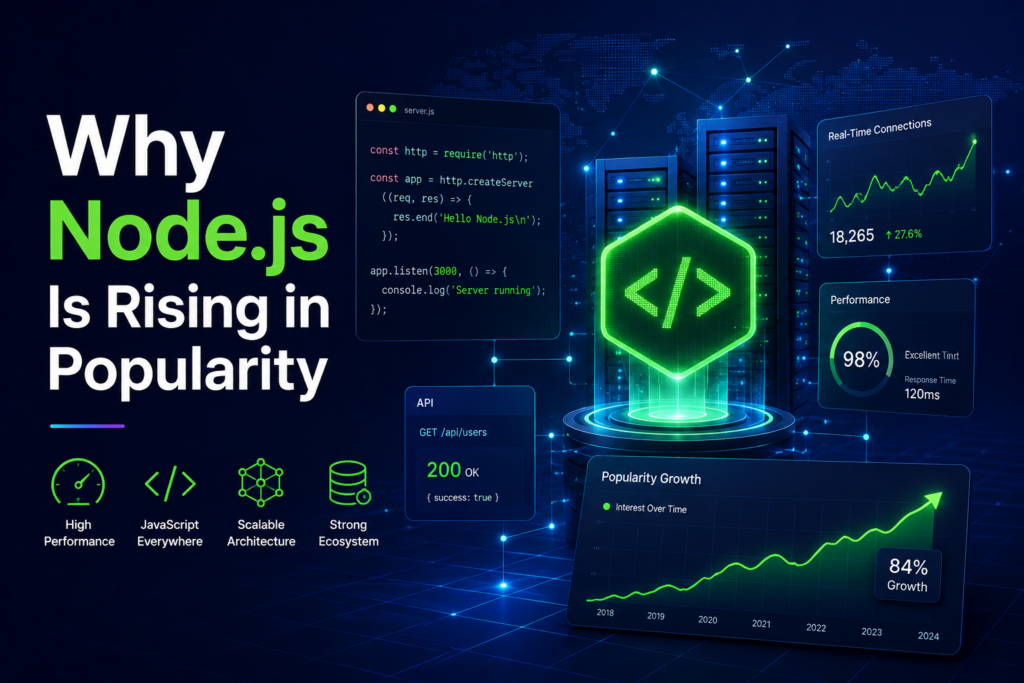
Node.js has become one of the most popular choices for building modern web apps, APIs, SaaS platforms, dashboards, and real-time applications. It lets developers use JavaScript on the server side, which means one language can power both the frontend and backend. Humanity finally found a way to reduce context switching, and somehow meetings still survived.
Node.js is especially popular because it is fast for many web workloads, works well with APIs, supports scalable network applications, and has a massive package ecosystem through npm.
What Is Node.js?
Node.js is a JavaScript runtime that allows JavaScript to run outside the browser. Instead of using JavaScript only for interactive website features, developers can use Node.js to build backend services, APIs, server tools, automation scripts, and real-time applications.
Its official documentation describes Node.js as an asynchronous, event-driven JavaScript runtime designed for scalable network applications. That matters because modern apps often need to handle many users, requests, messages, and API calls at the same time.
1. JavaScript Can Run Across the Full Stack
One major reason Node.js is growing is that JavaScript is already everywhere on the web. With Node.js, developers can use JavaScript for both client-side and server-side development. This helps teams move faster because they can share skills, patterns, validation logic, and sometimes code across the stack.
2. Node.js Works Well for APIs
Modern apps depend heavily on APIs. A mobile app may call an API for login, payments, user data, notifications, or reporting. Node.js is commonly used to build lightweight and flexible API services because it handles asynchronous requests efficiently.
3. It Supports Real-Time Features
Node.js is a strong choice for real-time features such as chat apps, live dashboards, collaboration tools, notifications, streaming updates, and order tracking. Its event-driven model helps applications respond quickly to many concurrent events.
4. It Has a Huge Ecosystem
The npm ecosystem gives developers access to thousands of packages for authentication, database connection, validation, file handling, payments, testing, logging, and more. This can speed up development, although developers still need judgment. Not every package on the internet deserves a place in production, shocking as that may be.
5. It Fits Modern Web Frameworks
Node.js works naturally with popular modern frameworks and tools such as Express, NestJS, Next.js, and many JavaScript build systems. This makes it common in startups, SaaS products, e-commerce platforms, and custom business applications.
6. Developers Continue to Use It Widely
Recent developer surveys continue to show strong use of Node.js among web technologies, and Node.js remains closely connected to the broader JavaScript and TypeScript ecosystem. This matters because technology popularity is not just fashion. It affects hiring, support, community help, packages, tutorials, and long-term maintainability.
When Should You Use Node.js?
Node.js is a good fit for APIs, web apps, dashboards, SaaS platforms, server-side rendering, microservices, real-time apps, and projects where the team already has JavaScript or TypeScript skills. It may not be the best choice for heavy CPU-intensive tasks unless paired with the right architecture.
Final Thoughts
Node.js is rising because it solves practical problems for modern app development. It gives teams speed, flexibility, scalability, and a shared JavaScript ecosystem across frontend and backend work. For many businesses, that makes Node.js a smart option for building modern, scalable applications.
FAQ
Why is Node.js popular?
Node.js is popular because it uses JavaScript, supports scalable network applications, works well for APIs, and has a large package ecosystem.
Is Node.js good for startups?
Yes. Node.js is often a good choice for startups because it supports fast development and scalable web applications.
Is Node.js only for backend development?
No. Node.js is mainly used as a runtime for backend and tooling, but it also supports build systems and full-stack JavaScript workflows.