
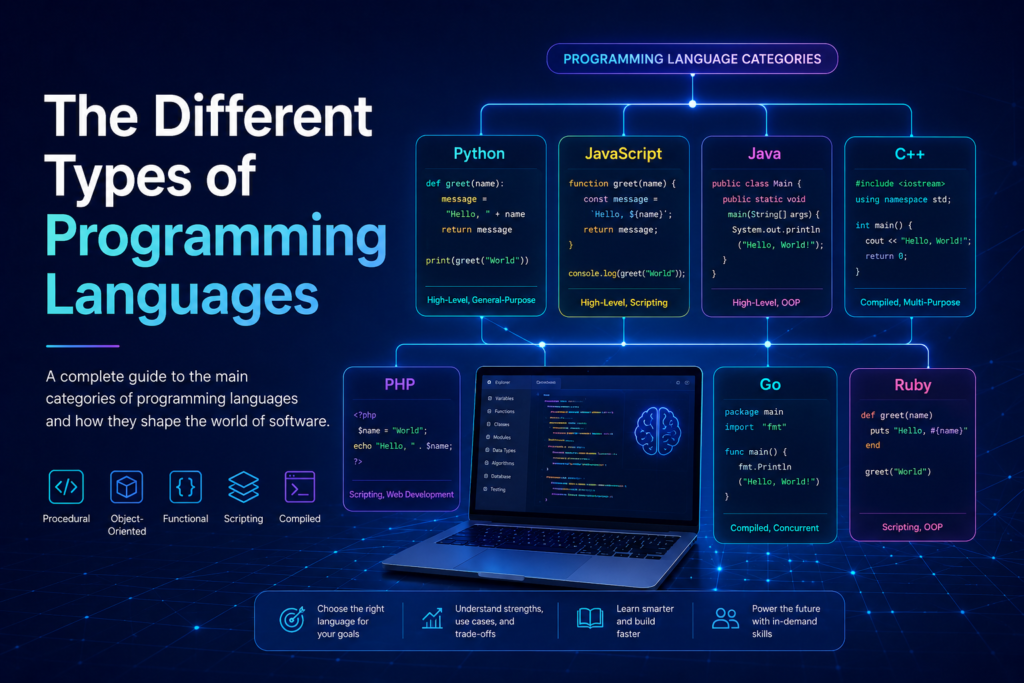
Programming languages are the tools developers use to build websites, apps, software, automation, games, dashboards, and intelligent systems. There are many types of programming languages, and each one is designed for different kinds of problems. Because apparently one way to talk to computers was not enough. Naturally, we invented hundreds.
Understanding the different types of programming languages helps you choose the right technology for your project, career path, or business application.
What Is a Programming Language?
A programming language is a structured way to give instructions to a computer. Developers use programming languages to tell software what to display, calculate, store, send, protect, or automate. Some languages are better for websites, some for mobile apps, some for data science, and some for high-performance systems.
Frontend Programming Languages
Frontend languages are used to build what users see and interact with in a browser or app interface. HTML structures the page, CSS styles it, and JavaScript adds interactivity. In modern web development, JavaScript and TypeScript are widely used for frontend frameworks and app interfaces.
Backend Programming Languages
Backend languages power the server side of an application. They handle user accounts, databases, APIs, business logic, permissions, payments, and other behind-the-scenes work. Common backend languages include JavaScript with Node.js, Python, PHP, Java, Ruby, Go, and C#.
Scripting Languages
Scripting languages are often used for automation, quick tasks, web development, and system operations. Python, JavaScript, PHP, Ruby, and Bash are common examples. They are popular because they allow developers to write useful programs quickly.
Object-Oriented Programming Languages
Object-oriented languages organize code around objects, which can represent real-world things such as users, products, orders, invoices, or vehicles. Java, C#, Python, PHP, Ruby, and JavaScript can all support object-oriented programming. This style helps organize large applications more clearly.
Functional Programming Languages
Functional programming focuses on functions, data transformation, and predictable results. It is useful in systems where reliability and clean logic matter. Languages such as Haskell, Elixir, F#, Scala, and parts of JavaScript and Python support functional programming ideas.
Compiled vs Interpreted Languages
Compiled languages are translated into machine code before running, which can improve performance. C, C++, Go, and Rust are common examples. Interpreted languages are often executed line by line or through a runtime, making them flexible and easy to work with. Python, JavaScript, PHP, and Ruby are common examples.
High-Level vs Low-Level Languages
High-level languages are easier for humans to read and write. Python, JavaScript, Java, and PHP are high-level languages. Low-level languages are closer to hardware and give developers more control, but they are harder to write. C and assembly language are examples often associated with lower-level programming.
Which Programming Language Should You Choose?
The right language depends on the project. For websites and web apps, JavaScript, TypeScript, Python, PHP, and Node.js are common choices. For data science and AI, Python is widely used. For enterprise systems, Java and C# remain strong. For performance-heavy systems, C++, Rust, or Go may be better.
The best language is not always the trendiest one. It is the one that fits your project, team, budget, performance needs, and maintenance plan. Revolutionary thinking, I know.
Final Thoughts
There are many types of programming languages because software problems are different. Some languages are built for speed, others for flexibility, readability, scalability, or platform support. Understanding the categories helps you make smarter decisions and avoid choosing technology only because someone online shouted about it with confidence.
FAQ
What are the main types of programming languages?
Common types include frontend, backend, scripting, object-oriented, functional, compiled, interpreted, high-level, and low-level languages.
Which programming language is best for beginners?
Python and JavaScript are popular beginner-friendly options because they are widely used and have many learning resources.
Which language is best for web apps?
JavaScript or TypeScript with frontend frameworks, plus backend options like Node.js, Python, PHP, Java, or Go, are common choices for web apps.